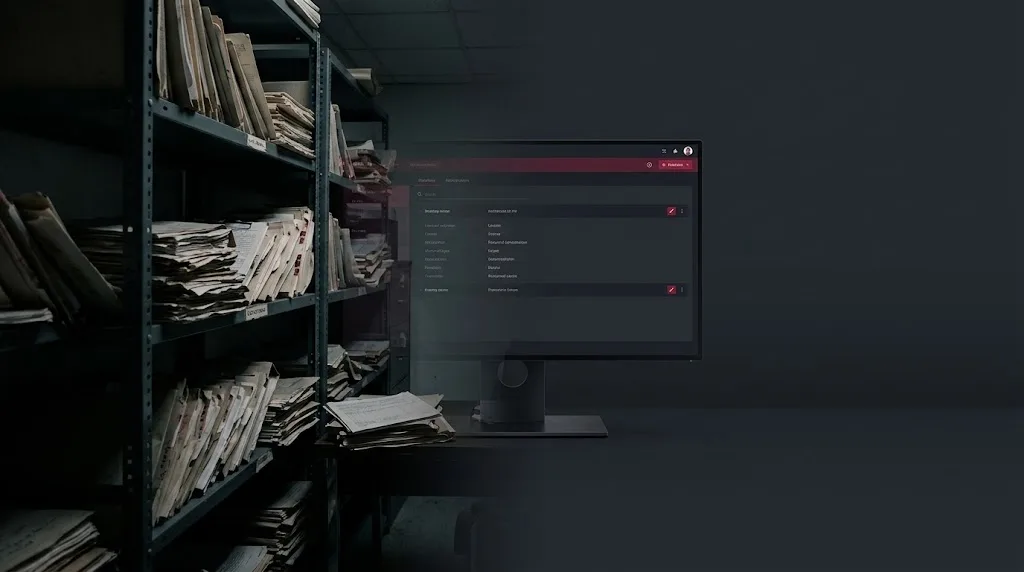
Built for the first sixty seconds
The console holds the numbers you would otherwise be recalling under pressure, and the timers keep running while you read.
IGNITE Health Systems for resident physicians
What you learn at the bedside does not follow you into the chart, or into the tool where you study for boards. Nobody ever wired them together.

Three in the morning
It is 3am and you are looking for one answer. Your hospital does not give you the evidence tool you would reach for, or nobody ever wired it into the EMR. So you go looking somewhere else.
You document the visit in the EMR. Weeks later you sit down to study for the boards in a completely different tool. What you learned at the bedside does not follow you into either one.
Nobody built this on purpose. These tools were made separately, by different people, for different jobs, and no one ever made them talk to each other. You are the part holding them together.
Protocols
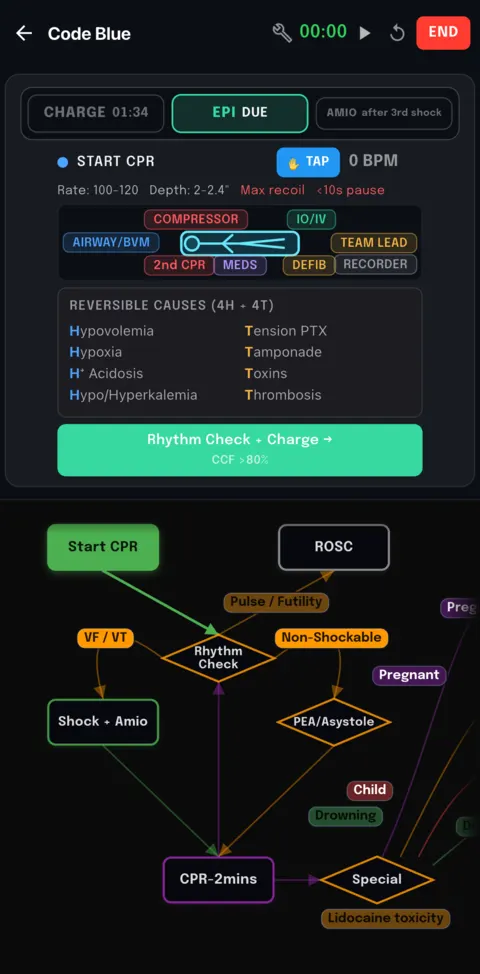
80 protocols across rapid response, admissions, labs, paediatrics, and calculators, plus an obstetric set that opens for OBGYN clinicians. These are captures of the current build, in beta on iPhone and Android.
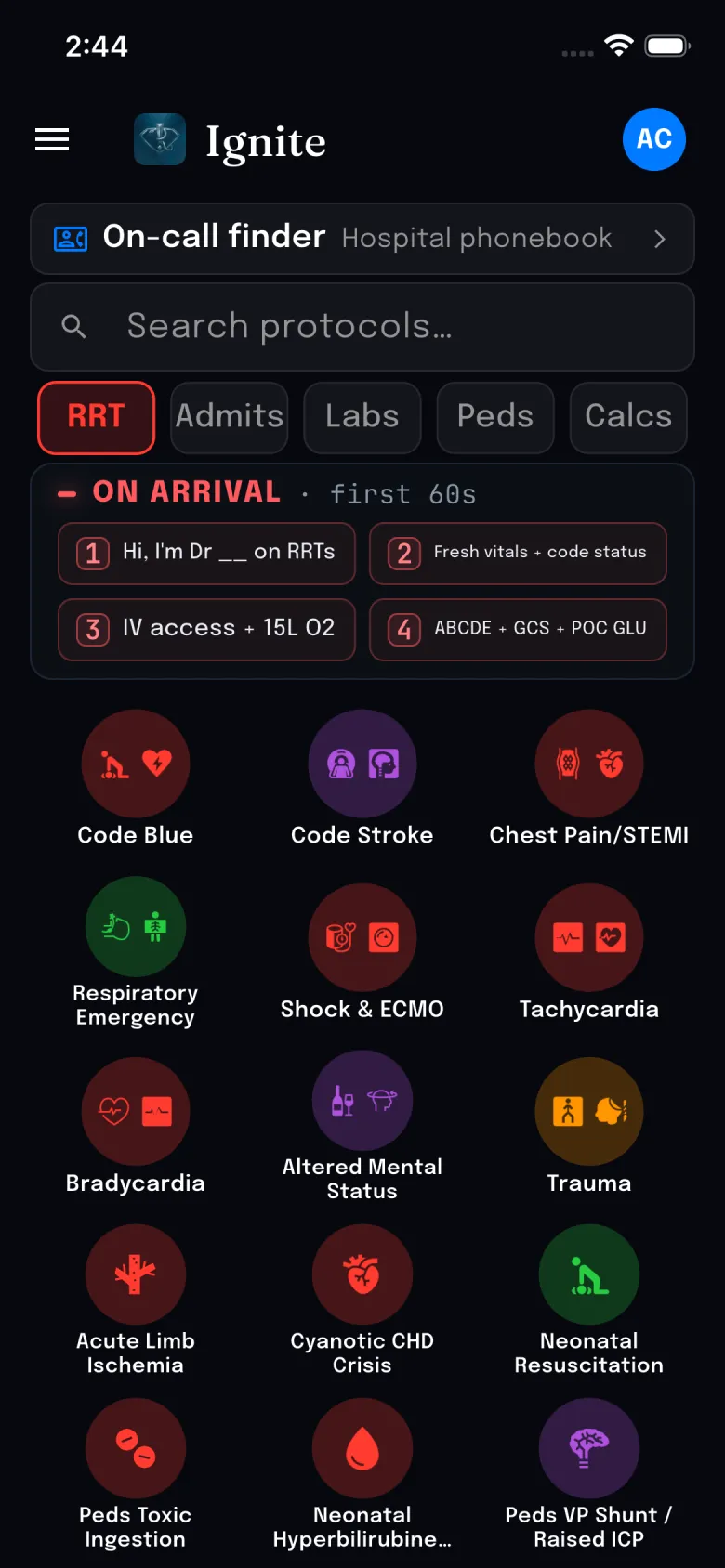
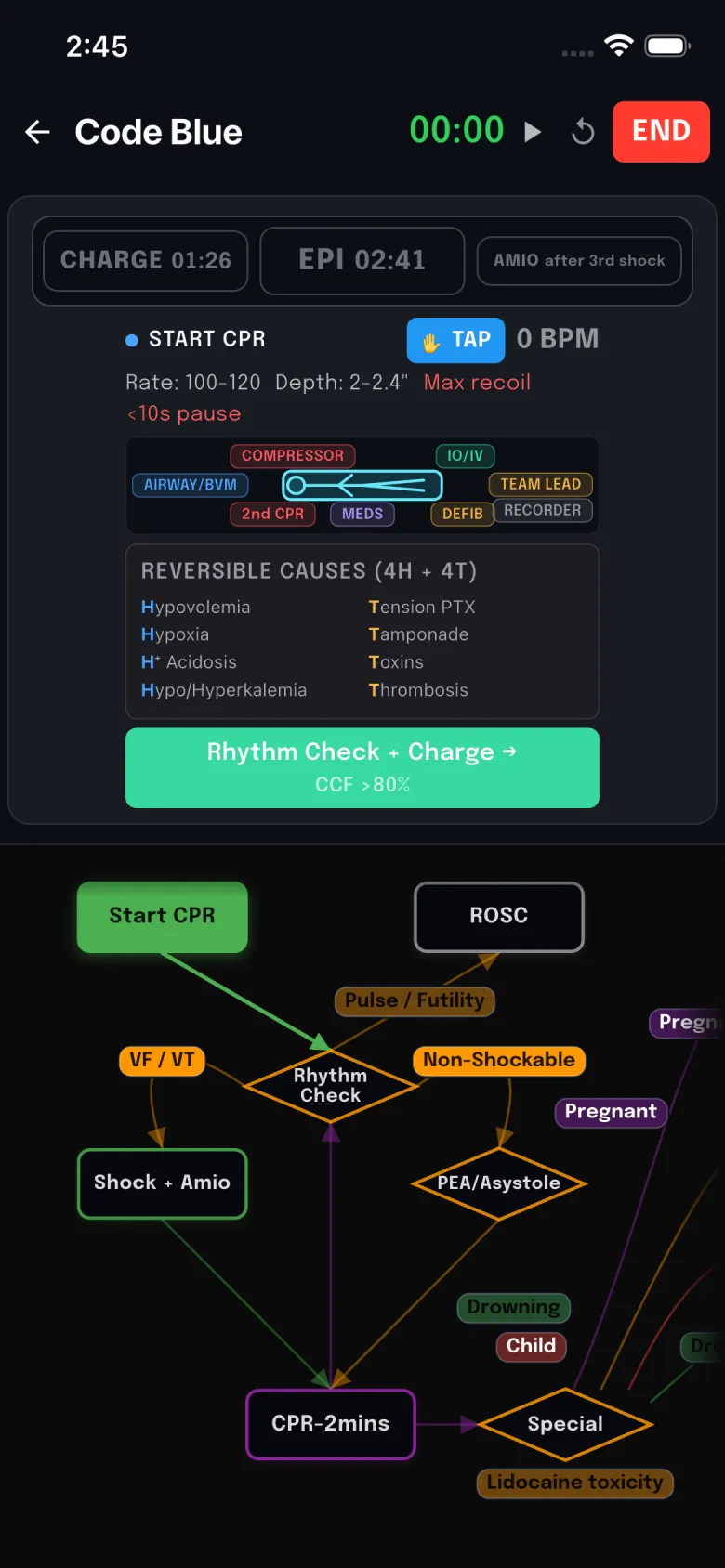
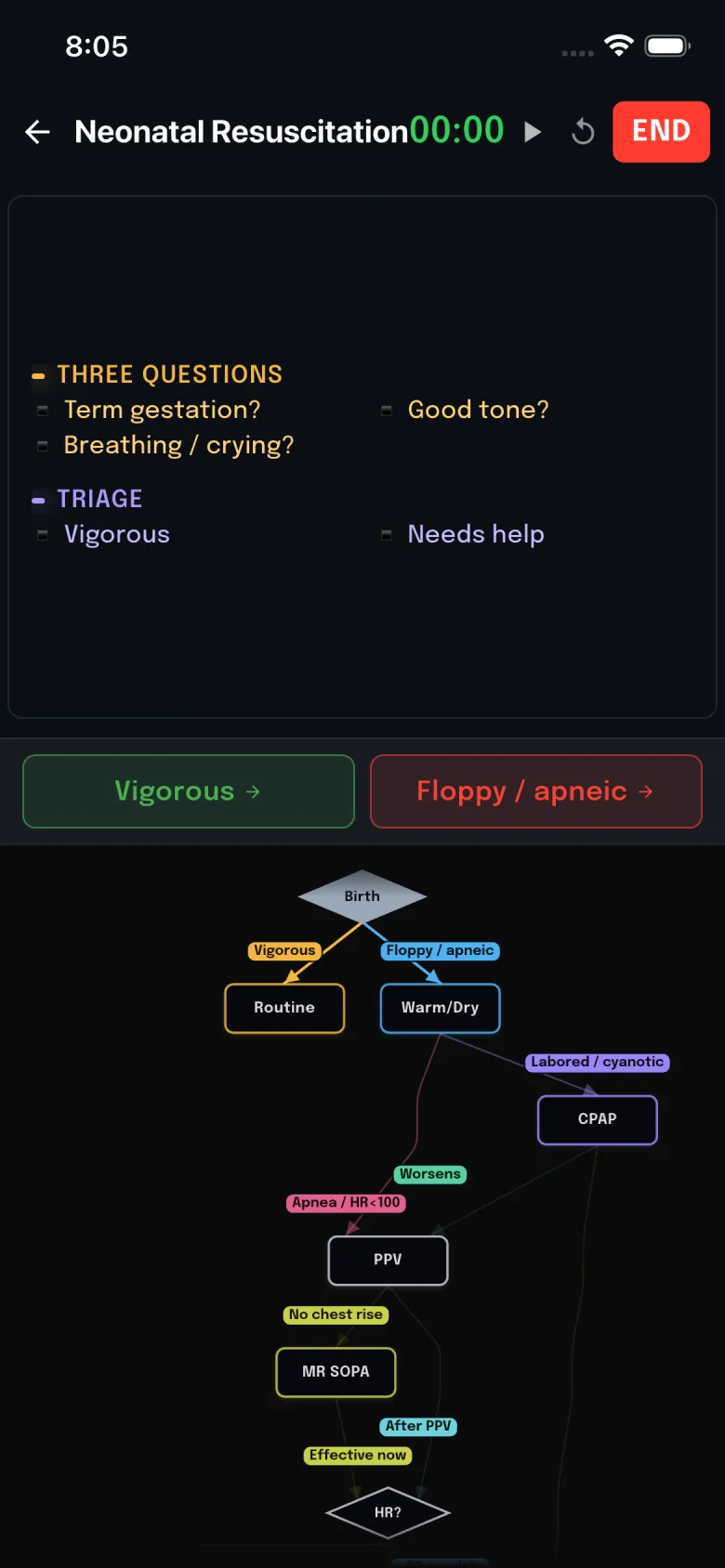
The console holds the numbers you would otherwise be recalling under pressure, and the timers keep running while you read.
Code Blue carries 14 decision nodes, including maternal arrest, local anaesthetic toxicity, drowning, and paediatric dosing.
All 80 protocols and 8,912 board questions currently meet on the same clinical particles, so a protocol step and a question about it are the same entity underneath.
Physicians document care while also completing coding, billing, prior-authorization, order, and inbox tasks. Published studies measure the cost and time attached to that administrative work.
spent on health care administration in a single year, which is 34.2% of US national health expenditure. Canada, whose payment system resembled ours before its reform, spends roughly half that share.1
Administrative spending includes prior authorizations, coding review, documentation requirements, billing, and other payment operations.
Growth in the number of health-care managers since 1970. The number of physicians grew roughly 250% over the same period.2
The study compared clinician EHR activity across 371 health systems using the same vendor in the United States and abroad.3
The median US clinician spends as long in the record each day as a non-US clinician in the 99th percentile.
These measurements describe time and spending assigned to record, billing, and administrative work.
MEDFlow supports clinician-controlled local records for prescriptions, referrals, and prior authorizations. Clinicians review and sign pended orders. External delivery and status depend on the configured integration.
Current product workflows
MEDLearn handles study records. Protocol routes display configured clinical guidance. MEDFlow stores supported workflow records. Evidence search returns source-linked clinical records.
MEDLearn
Board questions, source-linked explanations, flashcards, and FSRS review across 8 board specialties.
Current behavior
Answers update topic accuracy and flashcard schedules in the signed-in learner account.
Protocols
Institution-configured protocol records available on web and mobile routes.
Current behavior
Organization settings determine which configured protocol record is shown.
MEDFlow
Clinician-controlled local records for prescriptions, referrals, and prior authorizations.
Current behavior
Clinicians create, review, sign, and track supported work. External delivery and status depend on configured integrations.
Evidence search
Search clinical concepts and review the source records returned with an answer.
Current behavior
A clinician can record disagreement with a recommendation and supply a reason for review.
Each route states what it records today. Clinical review and signature remain with the clinician, and external delivery depends on the configured service.

Bolted on
The references, the question bank, the flashcards, the duty-hour and procedure logs, the place you document: each was built separately, for one job, and attached to what was already there. Every attachment is another seam, and you are the one carrying information across them. That is why the work of the day outlasts the day.
IGNITE was rebuilt as one machine. Asking, studying, testing and treating run on the same clinical knowledge graph, so what you learn in one is already there in the next. The recommendation is worked out by rules over that graph, against the patient in front of you, and it arrives carrying its grade and its source. A language model is only handed what has already been decided. It can word a recommendation poorly. It cannot invent one.
The loop
Learning, protocols, practice, and evidence are not four subscriptions that happen to share a login. They are four points on the same circle, and the circle is what nobody has built.
01
The case is the source of everything downstream. It is also the part no software has ever captured, because the moment it ends you are already documenting it somewhere else.
02
Open the protocol and the console holds the energy, the dose, the timer, and the reversible causes. The flowchart tracks which decision you are actually on.
03
Questions are filed by specialty and board blueprint domain, and they meet the protocols on shared clinical concepts rather than sitting in a separate library.
04
FSRS schedules the next review from your own answer history, so what you met at the bedside returns before you have lost it.
One account, one knowledge graph, one set of clinical entities under all four. Nothing is exported between them because nothing was ever separate.
March 27, 2026 · House Judiciary Committee
"A residency hiring monopoly that harms patients, doctors, and the American public."
— Interim Staff Report, Committee on the Judiciary / Subcommittee on the Administrative State, Regulatory Reform & Antitrust
Residency applicants rank programs before Match results establish their training position. Changing programs later requires another placement and approval from the programs involved.
Board-question banks, clinical references, journal quizzes, and flashcard tools are usually separate purchases. Residents also maintain the study records that connect those resources.
In March 2026, the House Judiciary Committee published an interim staff report about competition in the NRMP Match and its effects on residents and patients.
Published administrative and workforce evidence
Board preparation, reference databases, flashcards, and documentation tools keep separate subscriptions and records. Residents move among them and maintain their own study history.
The Oregon evaluation measured lower health spending after investment in patient-centered primary care homes. It reports the savings shown here for the program studied.
The AAMC model projects a primary care physician shortfall of 20,200 to 40,400 by 2036. Documentation and study work are named parts of the physician workload.
MEDLearn provides board questions, source-linked explanations, flashcards, and study records across 8 board specialties.